Bumblefoot
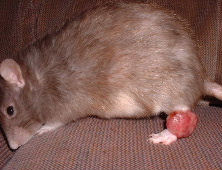
A few years ago I took in two old mink Berkshire ladies, in need of a home. I called them Sahkyo (American Indian meaning "mink") and Shadi (American Indian meaning "older sister"). Both sisters came with 'bumbles' on each of their back feet, one of which, on Sahkyo's left foot, was large and raw.
Bumblefoot (ulcerative pododermatitis) is a sore or ulcer that grows from the underside of the rat's hind foot. Staphylococcus aureus (a bacteria) is often found in these sores, but it is not known whether the bacteria help to cause the problem, or whether they simply colonise the ulcer once it has formed. The cause of these ulcers is not really known, though many ideas have been suggested.
Possible causes
By far the most convincing factor is a genetic predisposition, often related to obesity. Other factors that may encourage a bumble to form are the tendency of older rats to walk 'flat-footed' on their hind feet, rather than on their toes and solid shelving in cages (as pooled debris and urine may increase the risk of infection. Diabetic neuropathy may also be a factor in a minority of rats.
Genetic factors
It certainly seems that bumblefoot does occur most frequently amongst related rats and this would also explain why one rat out of a group may develop bumblefoot when the others (living in an identical environment) do not.
Obesity
Many rats who get bumblefoot are certainly overweight. Some are not. Sahkyo (who had the worst feet of the pair), was of average weight, while her sister was overweight but had better feet! The fact that obesity may sometimes be associated with diabetes may also be a factor.
Walking flat footed
As rats get older they tend to lose the bouncy, high gait of their youth. They tend to carry their bodies closer to the ground, and it is possible that this might put extra pressure onto the hind foot pads, especially if the rat also has a weight problem and genetic predisposition.
Solid shelving
Solid shelving certainly seems to play a part, especially when made of plastic. This is thought to be due to the rat walking through urine pooled on the shelves. Urine itself can cause skin breakdown, but certainly where a rat has a tiny cut in the sole of the foot, it is plausible that walking through droplets of urine might increase the chances of bacterial infection in the wound. If a rat is housed in a cage with solid shelves it is wise to keep these clean; washing and drying on a daily basis.
Diabetes
A breeder in the USA has put forward a theory that bumblefoot may be similar to the foot ulcers that often develop in humans with diabetes. Diabetics have reduced peripheral circulation, therefore small cuts can easily become larger wounds that are difficult to heal. She had a number of related rats with obesity, diabetes and bumblefoot.
Treatment
Bumble foot is notoriously difficult to treat, but some treatments have been found to be affective by some people. these include:
- Systemic antibiotics can help where there is infection present.
- Blue-Kote (can be obtained via the internet from the USA), or it's UK equivalent, Purple Spray (thought to be less effective), are topical applications which are applied directly onto the sore. They are both extremely messy, and it is not known what effects occur if the rat licks them off.
- Steroid creams may have an anti-inflammatory effect.
- Fucidin cream (antibiotic) applied topically may also be useful.
- Cleaning with astringent cleanser such as chlorhexidine or betadine has helped in some cases.
- Bee propolis cream
- Probably the best and most effective treatment in the early stages is changing the rats environment. The use of soft litters and beddings, removal of solid shelving and replacing with hammocks, and ensuring that the cage is kept very clean may all help.
- Bumbles can be surgically removed, but this can be difficult and healing may be slow due to the area affected.
Observations and related symptoms
On the whole the ulcers do not seem to be painful, and the main problem may be that they become friable as they grow and have a tendency to bleed. The chronic loss of small amounts of blood can cause the rat to become anaemic, and a diet rich in iron is helpful in preventing this. Sahkyo was extremely pale where she should have been pink (ears, toes etc), and she was given a daily dose of Minadex, which is a children's tonic containing iron. If the problem is more acute I have had good results with a bleeding, anaemic rat by giving vitamin k injections (help blood clotting), and anabolic steroids (these are different to the usual cortico-steroids given as anti-inflammatories, and boost the body's red blood cell production).
Sadly, Sahkyo did not respond to treatment, and her bumble grew to frightening proportions very quickly. My vet thought that it had almost certainly become cancerous, and as it engulfed a large portion of her foot (so was inoperable), and started to compromise the circulation to her lower leg and foot, she was put to sleep. However, her sister's more normal sized bumbles improved slightly with her new environment and bedding, and remained manageable throughout the rest of her natural life.